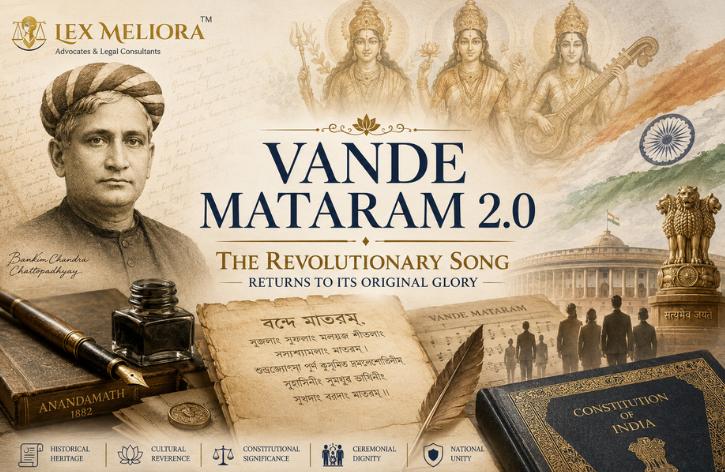
The national song of India, Vande Mataram, has entered a new chapter as the nation marks the 150th anniversary of its composition, with major policy updates restoring greater ceremonial prominence to the song while reigniting historical and constitutional debate.
- Recent Changes (2026)
As of May 2026, the Government of India has introduced a formal protocol for the song:
Mandatory Full Rendition:
The Ministry of Home Affairs has directed that all six stanzas, the complete original version, be performed at designated official events instead of limiting performances to the first two stanzas.
Order of Performance:
At official functions where both national symbols are rendered, Vande Mataram must be played first, followed by Jana Gana Mana.
Decorum and Standing Protocol:
A uniform ceremonial protocol now requires attendees to stand at attention during the rendition, similar to the observance followed for the national anthem.
Legal Status:
The Union Cabinet has approved amendments to the Prevention of Insults to National Honour Act, 1971, proposing legal penalties for deliberate insult or obstruction during the singing of Vande Mataram, significantly elevating its legal and ceremonial standing.
However, an important clarification remains:
Vande Mataram is still the National Song, while Jana Gana Mana remains India’s only National Anthem.
- History and the “Missing” Stanzas
Origin:
Written by Bankim Chandra Chattopadhyay in 1875 and later included in his 1882 novel Anandamath, Vande Mataram became one of the most powerful patriotic expressions during India’s freedom struggle, especially during the Swadeshi Movement of 1905.
The 1937 Division:
In October 1937, the Indian National Congress officially adopted only the first two stanzas for public and political use.
Why were the later stanzas removed?
The final four stanzas explicitly personify the motherland as Hindu goddesses:
- Durga – symbol of strength and protection
- Lakshmi – symbol of prosperity and abundance
- Saraswati – symbol of knowledge and wisdom
Objections were raised, particularly by the Muslim League and several minority representatives, who argued that such religious imagery conflicted with the secular and inclusive spirit needed for a united national movement.
To maintain communal harmony and ensure broad participation in the freedom struggle, only the first two stanzas were retained, as they celebrate:
- Nature
- Fertility of the land
- Beauty of India
- Cultural richness
These were considered universal and non-sectarian.
- Who Made the Decision?
The decision was taken by the Congress Working Committee (CWC) in Calcutta.
Jawaharlal Nehru:
As a leading voice in Congress, he emphasized the need to avoid alienating any community during a crucial period of anti-colonial mobilization.
Rabindranath Tagore:
Tagore’s opinion proved decisive. He argued that while the first two stanzas were poetic tributes to the motherland, the later verses were devotional hymns and could not be universally imposed.
Other Key Leaders:
The position was supported by:
- Mahatma Gandhi
- Subhash Chandra Bose
- Maulana Abul Kalam Azad
Their goal was to preserve the song’s patriotic spirit while ensuring it remained a symbol of unity.
- Why the 2026 Restoration Matters
The restoration of the complete six-stanza version reflects a broader effort to reconnect with India’s civilizational and literary heritage.
Supporters argue that:
- The original composition should be respected in full
- The goddess imagery is symbolic, not exclusionary
- The song’s historic role in the freedom struggle deserves complete recognition
Critics, however, continue to raise concerns about inclusivity and constitutional secularism.
Final Take
The official recognition of all six stanzas of Vande Mataram marks a historic restoration of one of India’s most powerful symbols of national awakening. By reinstating the complete composition—including the sacred invocations of Maa Durga, Maa Lakshmi, and Maa Saraswati—the nation has reaffirmed the song in its original literary and civilizational form as envisioned by Bankim Chandra Chattopadhyay.
This development is not merely a procedural change in ceremonial protocol; it represents a conscious acknowledgment of India’s cultural heritage, spiritual symbolism, and freedom struggle legacy. The restoration corrects a historical truncation that was once adopted as a political compromise and restores the song’s complete philosophical depth, where the motherland is revered as the embodiment of strength, prosperity, and wisdom.
At the same time, its continued status as India’s National Song reinforces its constitutional significance as a unifying patriotic expression that transcends generations. The 2026 protocol elevates its ceremonial dignity while reaffirming that national identity is rooted not only in constitutional structures but also in the cultural and civilizational consciousness of the people.
The return of all six stanzas of Vande Mataram stands as a powerful reminder that India’s national symbols draw their greatest strength from both historical sacrifice and timeless cultural reverence.
Recent Posts

-
Vande Mataram 2.0
May 11, 2026 -

Death in a bottle
April 16, 2026 -

Criminal Theory Behind the Accused under the POCSO Act
January 10, 2026 -
Navigating Divorce: A Step-by-Step Guide
September 25, 2025
Leave a Reply